


The Great Depression was the largest economic calamity of the 20th century, causing widespread unemployment, poverty, and suffering. US GDP fell by a third from 1929-1933, with compounding effects for the following decade. Over those four years alone, cumulative lost output was roughly equivalent to an entire year of pre-crisis GDP.
It may surprise, then, that Mark Gongloff, an opinion editor and columnist at Bloomberg, claims we have recently “suffered” double those losses to climate change via disaster cleanup, increased insurance premiums, and “other expenses”. In his piece “Ignoring a $7 Trillion Financial Disaster Won’t Make It Go Away”, Gongloff writes “climate change is already twice as painful economically as the Great Depression”.
Are we so oblivious to economic distress, or is he playing games with the rhetoric? The Depression announced itself through mass unemployment, breadlines, and visible deprivation. The absence of comparable signals today is not a mystery — it is evidence that the comparison fails a basic reality check.
Gongloff cites a twelve-year cost of climate change at $6.6 trillion, comparing it to a $3.3 trillion inflation-adjusted estimate of Great Depression losses over a similar span.
To call these numbers misleading would be an understatement. The GDP-normalized equivalent loss of the Great Depression would correspond to roughly $25–30 trillion today in foregone production. By contrast, his $6.6 trillion climate figure comes from an economy that is approximately 13–17 times larger than it was in 1929 in real GDP.
On a like-for-like basis, two “Great Depressions” would conservatively imply losses of $50–60 trillion in today’s dollars — an order of magnitude larger than the climate estimate he invokes. In another context, it would be akin to claiming the United States and Brazil would suffer equally from a $6.6 trillion loss, despite their vastly different economic scales.
The same methodology also implies that the Great Recession was far more economically “painful” than the Great Depression or climate change — but again only if relative economic scale is ignored. That implication alone should give readers pause.
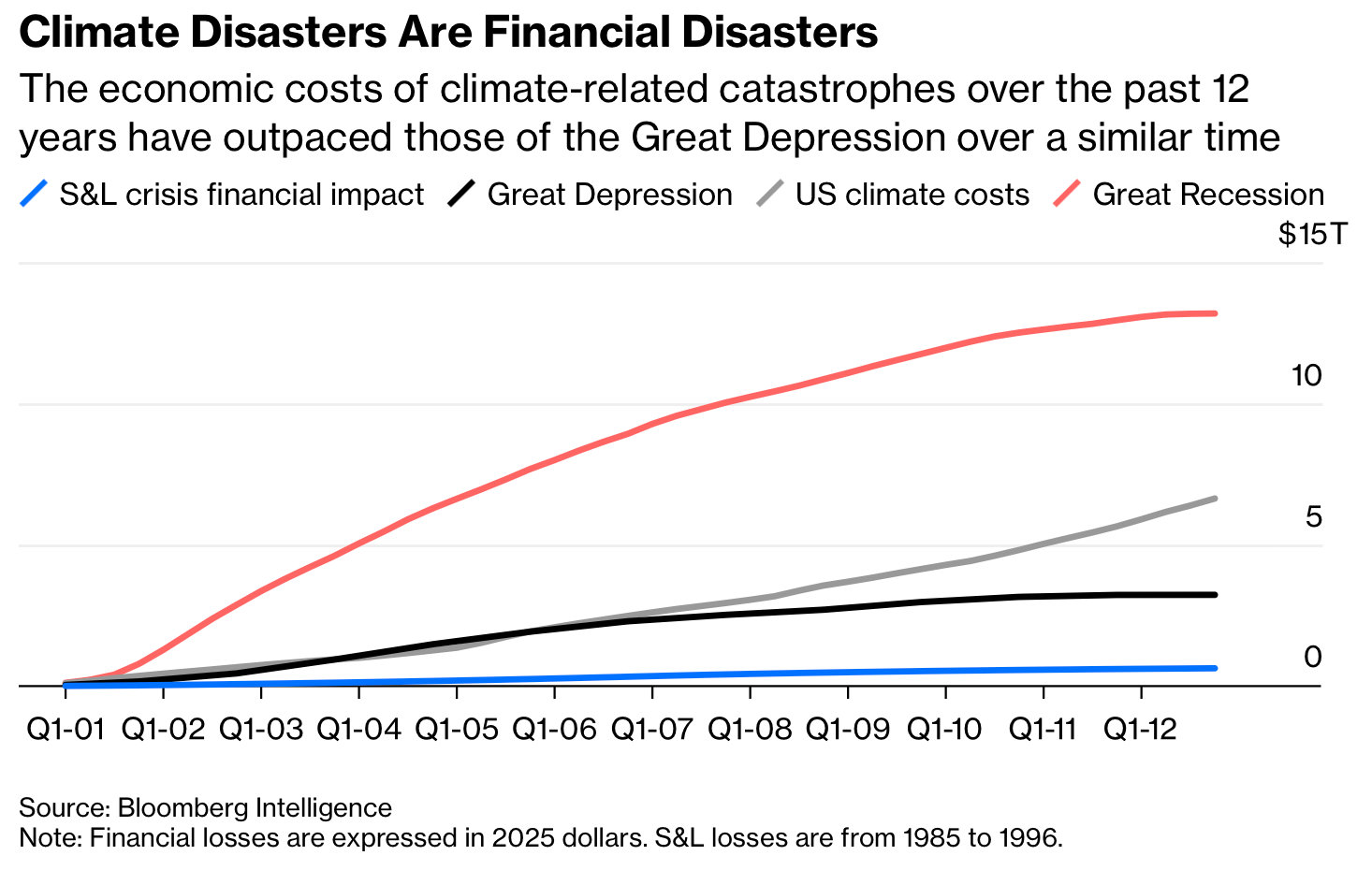
According to Gongloff’s own graph, climate change is presented as roughly half as costly as the Great Recession, a comparison that receives far less emphasis. The choice of comparator, rather than the consistency of the logic, appears to be doing much of the rhetorical work.
Diving deeper into the cited Bloomberg Intelligence report, the estimated economic cost of climate change from 2000–2025 is approximately $7.7 trillion — equivalent to 36% of total U.S. GDP growth over that period. Spread across a quarter century, that represents a long-run drag, not a sudden collapse in output. Even taken at face value, it amounts to roughly one-third of the GDP-normalized cost of a single Great Depression.
The Depression was not catastrophic because of a large cumulative dollar figure; it was catastrophic because output collapsed relative to the size of the economy, triggering mass unemployment and systemic distress. Treating it as a benchmark for cumulative climate costs confuses fundamentally different economic events.
Gongloff published this story at a major financial news institution six months ago without substantive pushback. He has written subsequent articles citing this misleading comparison, most recently “The Fed Is Heading for an F on a $7 Trillion Test”.
What does it say that this faulty equivalence has gone unchallenged? As Trump and the Fed crack down on climate change spending and regulation, climate-policy advocates are further incentivized to prioritize narrative over fact.
It’s not surprising that they would adopt an alarmist tone; a sense of urgency is key to the agenda. But when the economic harm is so profoundly overstated, it can only have the opposite of the intended effect.
This is the same overreach which has plagued the media class for the past decade and led to a disastrous loss of trust among the public. Yes, Gongloff wrote an opinion piece — but these numbers and their interpretation were not presented as opinion but as empirical evidence.
Facts cannot continue to be distorted in favor of “moral clarity” on climate change or other partisan darlings. If we’re serious about moving the needle on these issues, we need to treat our audiences seriously.
Bloomberg Opinion and columnist Mark Gongloff were contacted for comment but did not respond prior to publication.