

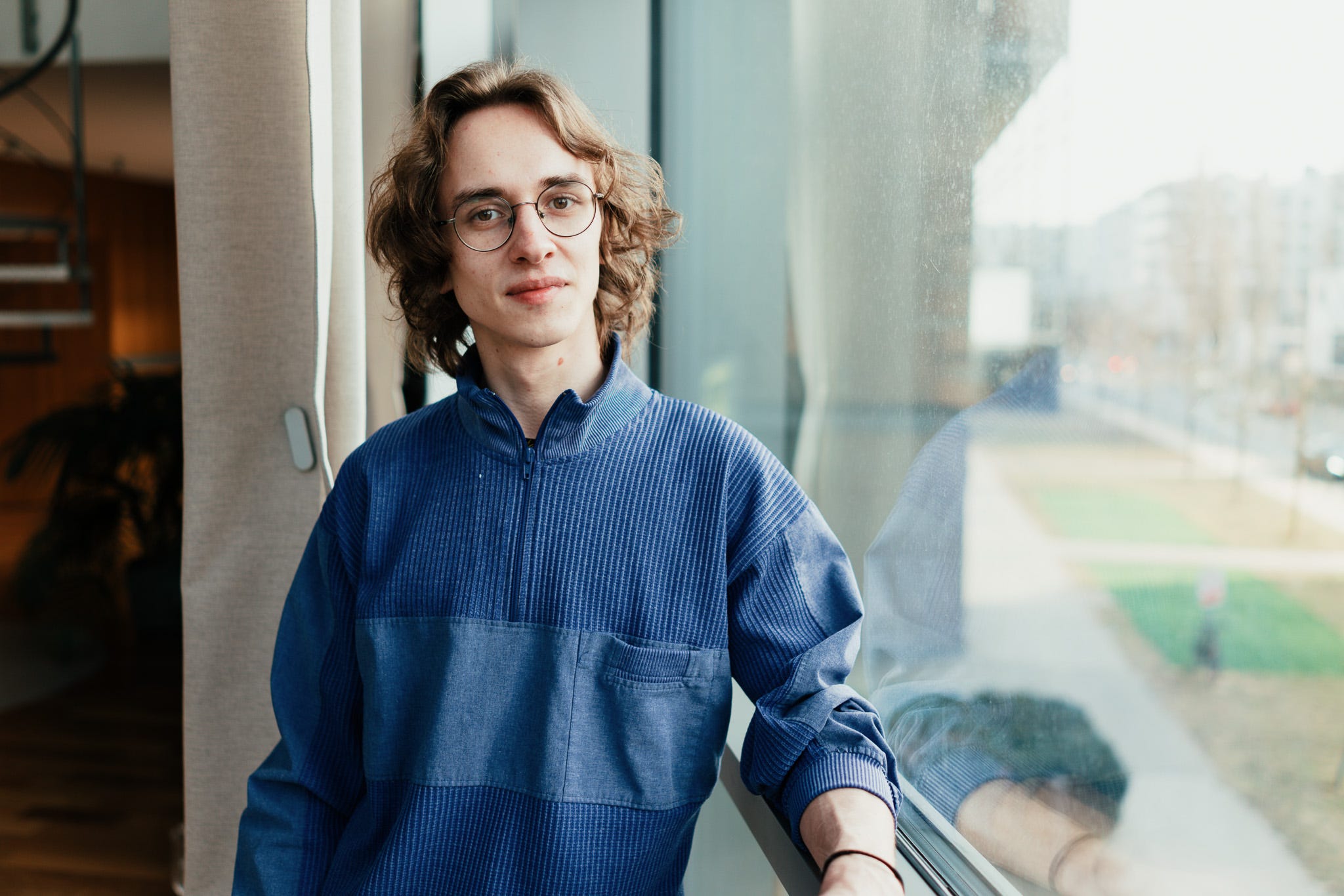
He woke before dawn to a flurry of activity on his phone: it was war. “I remember the first few hours like they were yesterday — a flashbulb memory. I looked out the window and thought, I’m fucked.”
Mykhailo was living in a small town near one of the largest military bases in Ukraine; commuting an hour to school in Lviv. It was the kind of place where you could shout a friend’s name from the street and they would come down.
His father, a taxi driver, was away on the job. The rates spiked fifty-fold the day of the attack, earning him more than a month’s salary. He later picked up Mykhailo and told him they were going to his grandfather’s village, about twelve kilometers from the Polish border, to wait out the danger.
“When we got there, he told me I wasn’t staying. He had packed my suitcase. I was going to Poland.”
Mykhailo didn’t want to leave; he worried for his girlfriend. His bag was filled with ill-fitting clothes and lacked essentials. He negotiated for one more day.
He arrived at the Polish border better prepared, but alone — she had stayed behind. He was greeted by bitter cold and a line of thousands seeking refuge. “Women and children went first, but at sixteen I didn’t really count. I stood for nineteen hours, and by the end I was shaking uncontrollably. Then I waited another five hours on the Polish side for a bus.”
After days of couch surfing in Warsaw, Mykhailo found himself adrift. He could only check the news so many times. On a previous visit to the city with his father, they had come across a Steinway piano shop.
“They sell grand pianos — very different from the old, beat up ones I was used to. You can feel the difference in the travel of the keys, the sensitivity. They had rooms where you could pay to practice, but I didn’t want to beg. I asked if they knew somewhere I could play for free, and the manager offered to let me practice a few hours a day.”
Mykhailo was quickly accepted into a music school and found himself a smaller fish in a much larger pond. “In Ukraine, I was really good. Here, I was average.” He took to the Polish language quickly, though found difficulty in the finer points of pronunciation. “My Polish sounded Ukrainian, and soon my Ukrainian sounded Polish.”
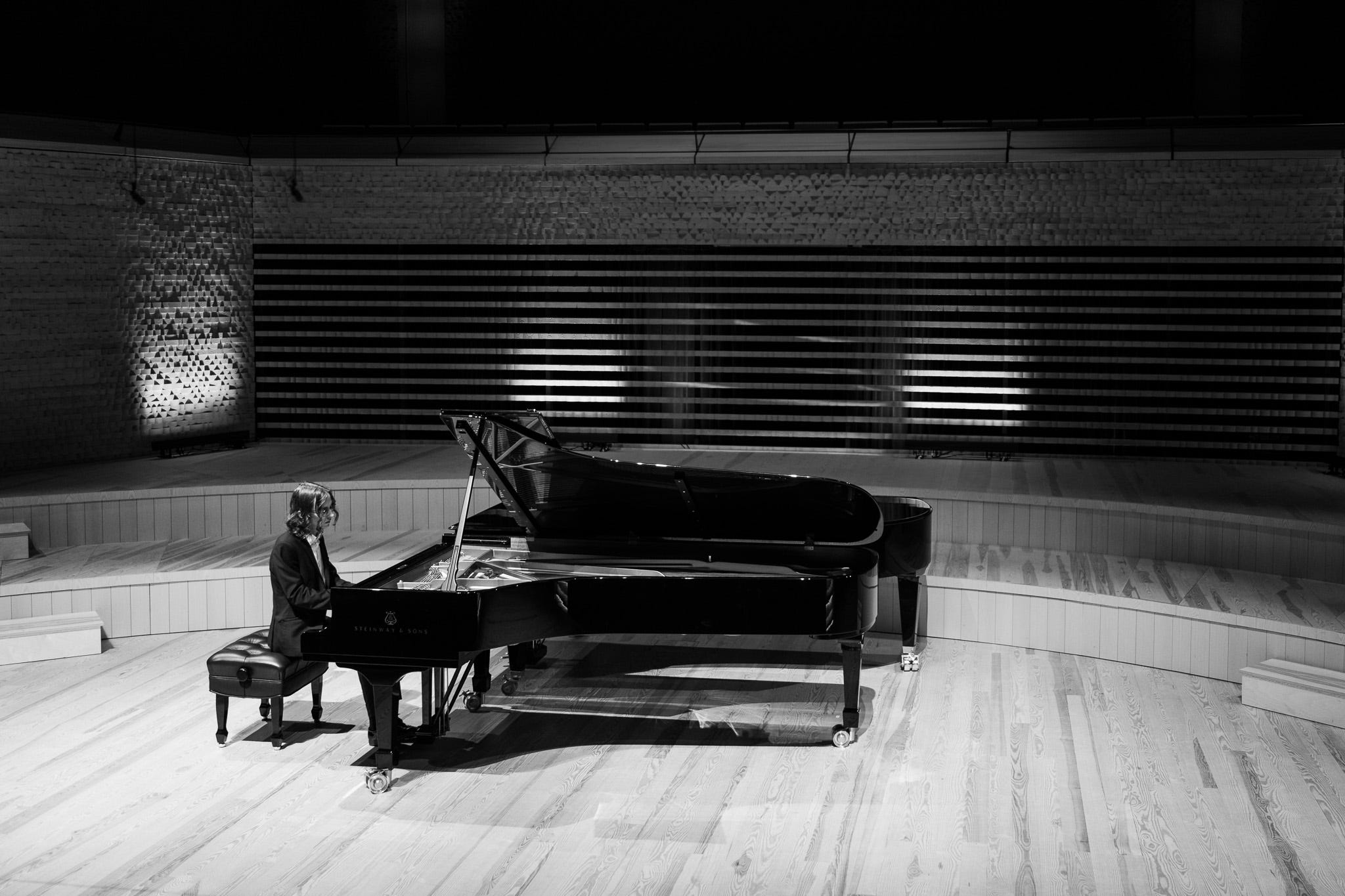
In the summer of 2025, Mykhailo performed his music school recital in Warsaw. The program ran over an hour in a crowded concert hall; half-solo, half-duet. He played selections from Bach, Beethoven, Revutski, and, naturally, Chopin. It was a far cry from his musical past in Ukraine and his desperate first steps into Poland.
The performance was demanding: “You have to concentrate to play really well. I was stressed, but didn’t feel it at first — until I noticed my leg was shaking. I had to think about every note, what comes next, when to start building to a crescendo. You have to think ahead, because when you play max volume on the piano you can’t go higher.”
Despite Mykhailo’s humble self-appraisal, the judges evaluated him highly. His primary instructor, the Polish pianist Filip Wojciechowski, offered praise after the performance — an acknowledgment that he was keeping pace in a far more competitive field.
Classical music occupies a tortured place within Ukrainian culture. During the Soviet era, Russian composers were exalted and Ukrainians pushed aside. Shouting and physical abuse were common forms of instruction. Mykhailo recalls a female classmate trembling before practice; an elderly instructor punishing her missed notes with a ruler.
Mykhailo felt this diminished legacy acutely while growing up: “My friends didn’t understand the point of practicing for hours a day; there were few scholarships or opportunities.”
Still, he maintains a connection to his heritage. When asked about his favorite composers, he mentions Sergei Bortkiewicz, born in Kharkiv in 1877, who fled war and revolution, lost his home, and eventually rebuilt his life abroad. Another influence is Borys Lyatoshynsky, a Ukrainian composer whose career was shaped by the upheavals of the Second World War, and whose music resisted Soviet demands for “Socialist Realism.”
Mykhailo now studies psychology. He still plays classical piano, but has begun forming a band with friends, covering The Doors and Hendrix — a more relaxed kind of music, built on camaraderie over precision.
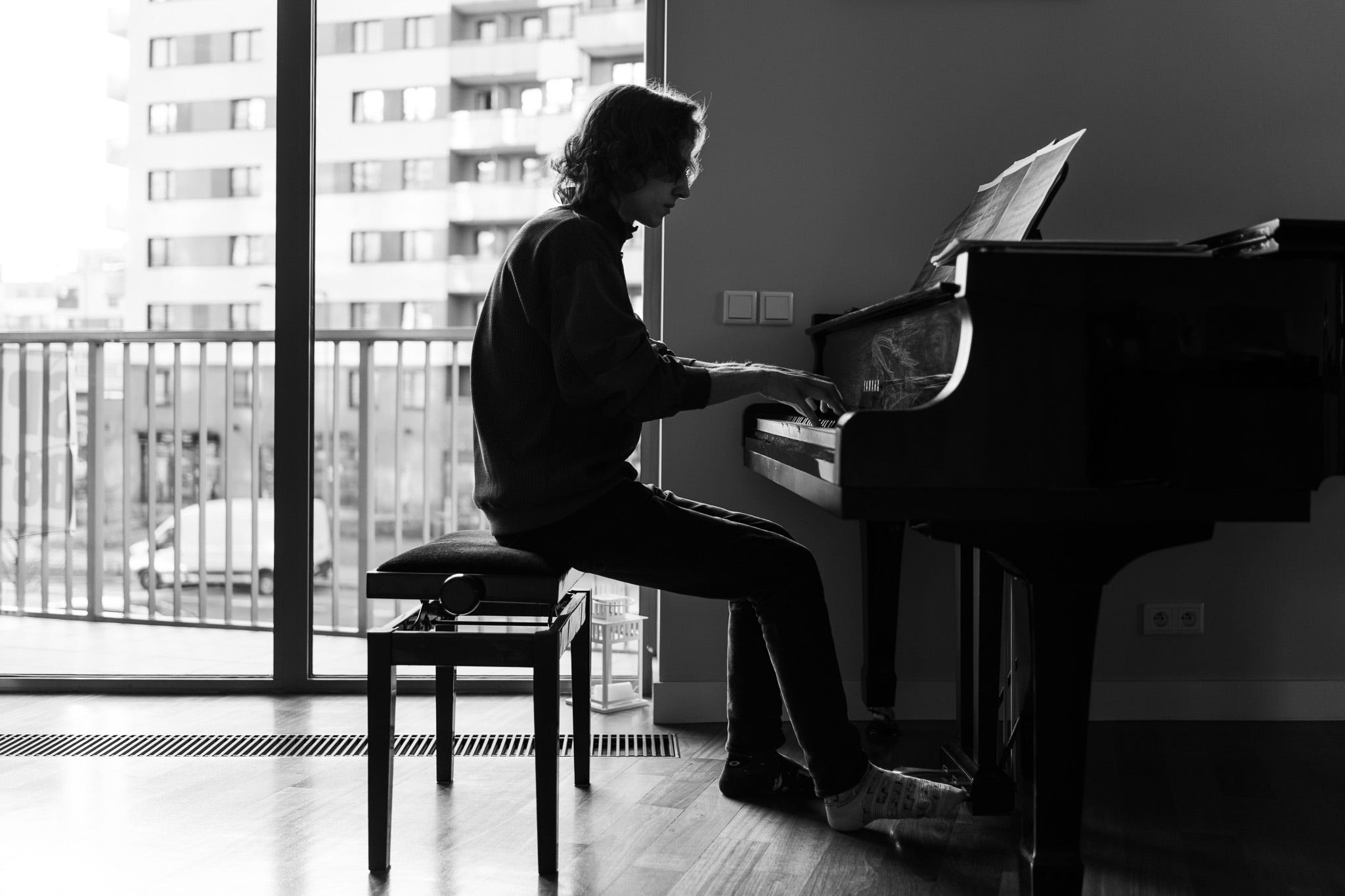
In the year since his recital, he hasn’t grown rusty. He sits at a Yamaha piano in David’s apartment, working through a passage before stopping midway, shaking out his hands, then starting again from the beginning.
His life in Warsaw has begun to take shape. His Polish girlfriend, Anna, also studies psychology, and works across visual mediums; from painting to interior design. She is a regular presence at his performances.
Mykhailo’s father serves in the Ukrainian military, something he speaks about with quiet pride. In recent months, he has helped organize a fundraiser to purchase equipment for his father’s unit — an effort David says is “very important and close to his heart.” He added that he admires how Mykhailo “supports his fellow citizens in every way he can.”
Asked about his current situation, his ambivalence is apparent: “I feel weird about the opportunities I have because of the war, and being in Warsaw. It breaks my heart that I am among the “lucky ones” and most Ukrainians aren’t. I am glad that I had this opportunity, but still, I experienced a lot of stress and had to overcome many problems along the way. I’ve minimized my losses.”
Recently, Mykhailo described a dream. He was on a train in Poland, trying to buy a ticket before an inspector arrived. What should have taken seconds stretched into minutes. He fumbled with the app. The language wouldn’t come. He tried to explain, unsure of what he was saying.
“I knew it was Polish,” he said. “But it didn’t feel right.”